Many rooftop solar kits pass a quick visual check with 12 AWG cavo that later underperforms or becomes unsafe. The cable often fails on UV rating, heat derating, or connector type—not on copper thickness. A bench test can look perfect while a real roof exposes the weaknesses. This article helps you avoid those hidden failures without guesswork.
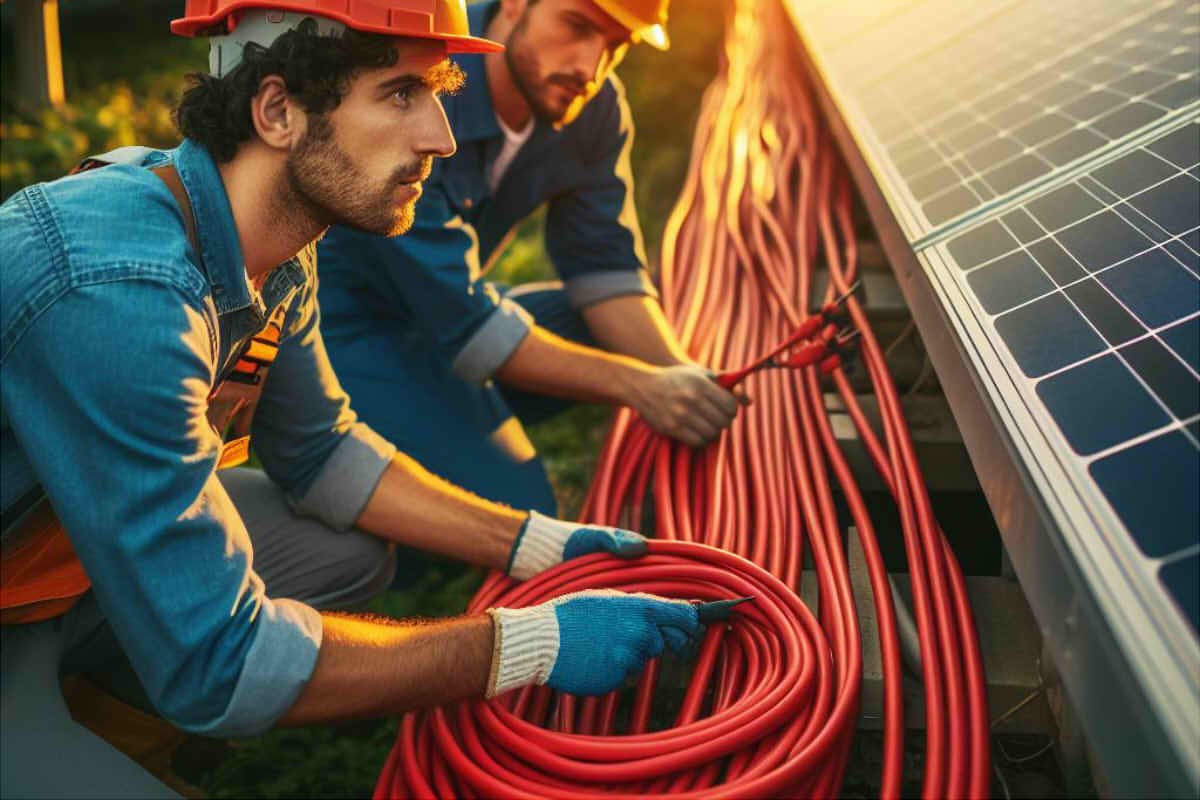
Rooftop solar kits often use 12 AWG because it balances ampacity, flessibilità, and cost for many residential arrays. But the word ‘solar’ matters only when the jacket meets outdoor standards. Se il cavo cannot handle UV, heat, and moisture, the copper size becomes irrelevant.
What Qualifies as 12 AWG Solar Cable for Rooftop Solar Kits
Never call any 12 AWG cable a true solar cable unless it carries a PV wire or USE-2 marking for wet, sunlight-resistant rooftop duty. These markings indicate the insulation can handle direct sun, moisture, and wide temperature swings on a roof. Plain building wire cannot safely perform that job. Check the cable jacket before you install it, not after the panels are up.
| Cable Type | UV/Sunlight Resistance | Wet Location | Rooftop Verdict | When to Choose |
|---|---|---|---|---|
| PV Wire | Alto | SÌ | Best for exposed rooftop DC runs | Direct sun, long outdoor runs, no conduit |
| USE-2 | High if marked sunlight resistant | SÌ | Acceptable for many rooftop circuits | Outdoor runs when the sunlight-resistant marking is present |
| THHN/THWN | Low unless inside approved conduit | Yes for W | Not for exposed rooftop solar | Inside approved conduit only |
| Romex/NM-B | No | No | Never for rooftop DC | Indoor dry locations only |
| Extension cord | No | No | Never | Temporary indoor use only |
The table gives a quick decision guide, but conditions matter. USE-2 only works for exposed rooftop DC when the manufacturer marks it sunlight resistant. THHN or THWN may work inside approved conduit, but not as exposed solar cavo. Verify local electrical code and the cable listing before you purchase. A jacket that looks tough in the store can still be the wrong material for a hot roof.
The Most Common Rooftop Wiring Mistakes With 12 AWG Solar Cable
Rooftop solar systems fail at predictable points. Watch for these eight mistakes and correct them before you close the junction box.
- Treating any 12 AWG cable as solar cable. Only PV wire or USE-2 marked for wet, sunlight-resistant duty belongs on a roof. If the marking is missing, do not trust it. The copper conductor may be the right size, but the insulation is the safety system.
- Substituting Romex, THHN, or extension cord wire outdoors. UV and temperature swings crack indoor insulation. Exposed copper can create shock or fire hazards. Even if it works for a few weeks, the jacket will degrade faster than you expect on a roof.
- Ignoring heat derating. A hot rooftop reduces what 12 AWG can safely carry. Check ampacity after temperature derating, not just the panel short-circuit current. High roof temperatures, conduit fill, and bundled runs lower the effective capacity. Use the manufacturer’s temperature derating chart and your local code for the correction factor.
- Forgetting round-trip voltage drop. Calculate the full circuit length—positive plus negative—not one-way distance. Keep voltage drop low, often under 2–3%, so long rooftop runs do not starve the charge controller. Use actual operating current after temperature corrections, not just short-circuit current.
- Twisting wires together or mixing MC4-style connector families. Do not combine different brands or designs. Use one compatible connector family and a proper ratchet crimp for low-resistance connections. Pliers crimps often leave high resistance that heats under load.
- Running cable over sharp flashing or metal edges. Protect the cable from sharp flashing, metal edges, and roof penetrations with UV-rated clips, grommets, or flex conduit. Do not pinch or kink it. A pinched jacket can let moisture in and expose the conductor.
- Mixing copper with copper-clad aluminum or leaving bare splices exposed. Stick to pure copper 12 AWG and sealed, strain-relieved junction boxes. Dissimilar metals corrode and bare splices invite arcs, especially in humid rooftop conditions.
- Coiling excess live cable tightly in direct sun. A coiled 12 AWG run can trap heat and reduce safe ampacity. Dress excess cable loosely in shade or trim it to length. Do not leave a working coil against a hot roof surface.
A Hypothetical Rooftop Scenario: Bench Success, Roof Sag
Per esempio, a team might test a short 12 AWG run on a bench, then reuse it on a long rooftop run and wonder why performance sags. The bench test hides two rooftop realities: voltage drop across a longer round-trip path and higher conductor temperature in direct sun. The fix is not thicker cable by default. It is a corrected design: derate for roof temperature, calculate total loop length, and keep terminations clean.
Rooftop Safety: Labels, Lockout, and Live DC Risk
Label positive, negative, and ground clearly at both ends of every rooftop DC run. Treat every rooftop DC cable as live in daylight. Solar panels produce voltage whenever light hits them, even with the system switched off. Use lockout/tagout procedures and insulated tools while making or breaking connections. Cover or isolate panel outputs when possible, and never assume open circuit means zero voltage.
Before you finish the installation, run this short safety pass:
- Confirm each conductor has a secure, strain-relieved termination.
- Verify all junction boxes are closed and gasketed against moisture.
- Check that no conductor touches a sharp edge or hot surface.
- Mark polarity at both ends of the circuit before connecting to the charge controller.
After you finish the labeling and clipping, step back and inspect the full route from panel to charge controller. Look for sagging cable that can flap in wind, areas where the jacket rubs against a roof penetration, and any coil left in direct sun. Small corrections at this stage prevent long-term insulation failure.
Which rooftop wiring pitfall surprised you most, or what condition on your roof are you double-checking before the next install? A quick review now can save a hot, long-run performance problem later.
ZMS Material, founded in 1980, is a manufacturer and exporter of wire & cable products serving B2B projects worldwide. We supply [power cables / control cables / building cables / submarine cables] to contractors, engineering companies and distributors, with IEC/CE-certified quality, project-based customization (OEM/ODM) and factory-direct pricing. For project inquiries, technical support or catalogs, contact us at [email / Whatsapp].